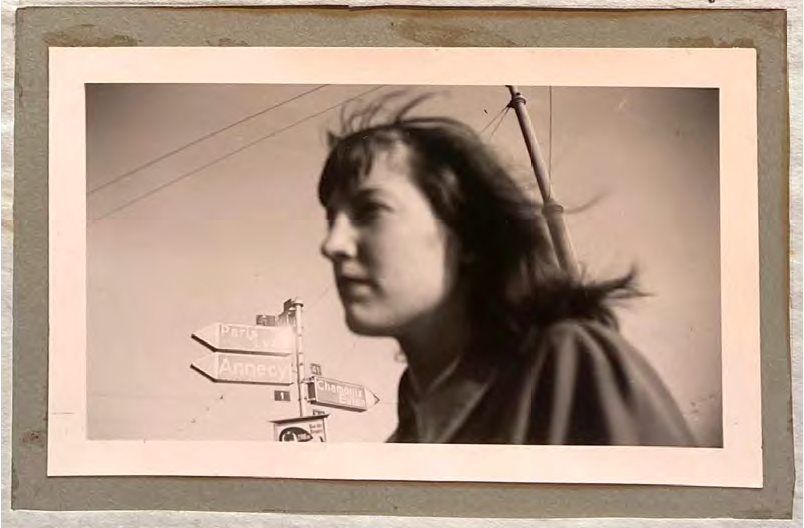
I'm in a room I've never been in before, listening to a letter being read aloud. It's the year 1947, and my grandmother—who isn't yet my grandmother—is writing from Europe. Her fiancé reads the letter to her family, who anxiously hang onto every word he says. Where is their daughter, sister, and soon-to-be wife? Who is Ann becoming?
A half-century would pass before I met her, and with it life's infinite variety of subtle transformations. She was not prone, in our conversations, to divulging the details of her inner experience, nor I to ask the right questions. I was content to rest within the force-field of her presence. It wasn't until after she passed away, in 2020, that I began to wonder about all that we left unsaid.
Some years ago, my mother found a collection of Ann's letters on an oversize book shelf in the family farm house. My grandfather, recipient of the letters, had collected, transcribed, and bound them, alongside adding his own introduction. Across more than 50 entries, my grandmother's voice soars and dips and dives as she describes the minutiae of a 4-month voyage with her close friend, Jo, across the Atlantic and on to France and Switzerland.
These letters come from a place within her memory—before all that life lived, before the hardening and shaping of her identity—that remains altogether foreign to me. This is my attempt to get there.
"It will be of increasing interest to those who care," my grandfather wrote in his introduction, "to have available these typewritten impressions of a 21-year old American girl (this is the sociological touch), three months out of Vassar College, turned loose on Europe two years after the end of World War ll." As the self-ordained editor of this collection, he was, in effect, selling it to a future reader (while also mocking the apparent necessity of selling it). But by the time my grandfather cedes the stage to Ann, these gestures have subsided into the background. If and when the world enters into her thinking, it is refracted like a ray of light—in other words, obliquely.
She was not trying to put to words the shambles of the European continent, or what it meant to be among the first generations of women who could comfortably travel abroad without the accompaniment of men, or the financial and symbolic power that Americans now wielded around the globe. She was writing, at least superficially, to reassure her fiancé and family of her safety and well-being. She did not expect an audience beyond them.
This puts me in a somewhat delicate role. Throughout this project, I have wavered around the idea of my grandmother's consent—whether it's needed, to what extent—but I can make some educated guesses, based on how she lived her life, as to what she might have wanted after it.
She always held on to the letters—this is a fact. But this is not the same as giving her blessing to publish and exhibit them as an archive might. Instead, Postscript offers a series of readings that allow me to grapple with this document while protecting the privacy of my grandmother's legacy. It is an inquiry into the dark matter of memory itself.